


Could methylene blue change the way we think about hair health?
An old compound is attracting new attention in research on mitochondria, oxidative stress and cellular ageing. But what does the science actually say about hair loss and greying?
What happens when cellular energy becomes part of the hair-health conversation?
Hair follicles are highly active structures. Researchers have therefore become interested in the biological systems that support cellular energy, oxidative balance and tissue maintenance.
Hair loss is usually discussed in terms of hormones, genetics, ageing and the environment. But underneath all of those factors is another layer of biology: the health and behaviour of the cells that make up the hair follicle.
That is where mitochondria enter the conversation. These structures help cells produce ATP, the energy required for countless biological processes. Because hair follicles undergo periods of rapid activity, researchers have asked whether mitochondrial function and oxidative stress could influence the follicle environment.
Methylene blue has become interesting in this context because laboratory research has explored its redox activity, effects on mitochondrial processes and potential influence on oxidative stress.
The interesting part is not that methylene blue has suddenly been proven to regrow hair. It hasn't. The interesting part is that researchers are investigating several biological pathways that may be relevant to healthy ageing and cellular function.
The evidence is still developingWhy are mitochondria so interesting?
Mitochondria are often described as the powerhouses of cells, although their role is much broader than energy production alone. They participate in signalling, metabolism and responses to cellular stress.
When cells are under excessive oxidative stress, reactive oxygen species can damage proteins, lipids and DNA. Researchers studying ageing therefore frequently examine the relationship between mitochondrial function and oxidative balance.
Methylene blue has been studied as a redox-active compound.
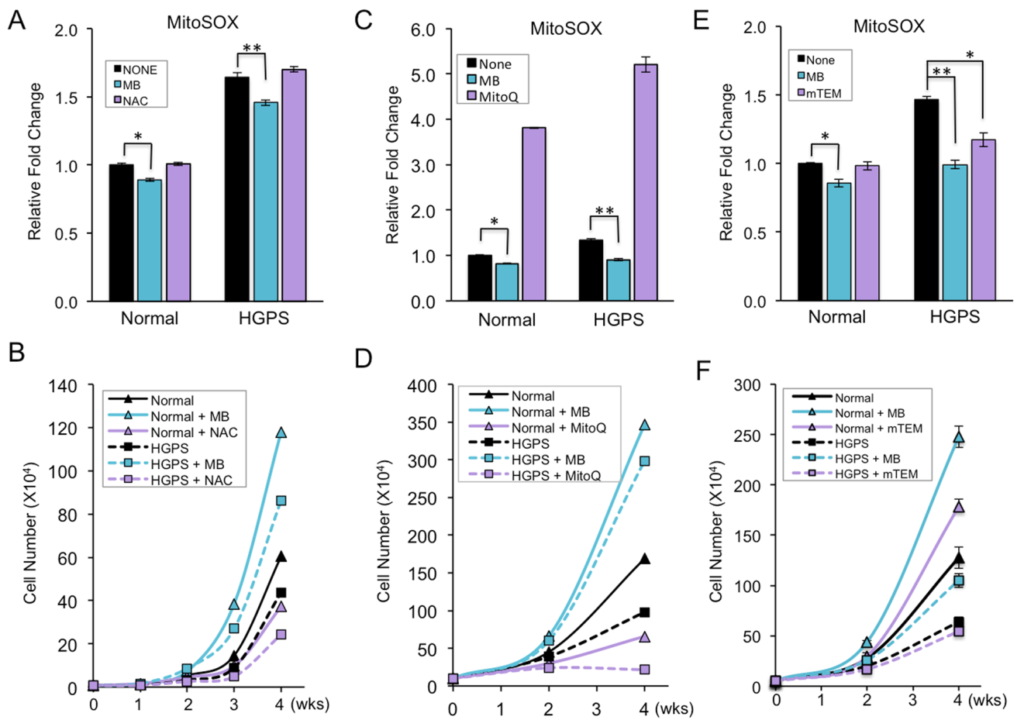
Laboratory research has investigated whether methylene blue can participate in electron-transfer processes and influence mitochondrial function. These findings are scientifically interesting, but laboratory mechanisms are not the same thing as a demonstrated clinical benefit.
Source: Xiong et al., Scientific Reports (2017). Figure reproduced from the cited research article under the source article's stated Creative Commons licensing.
What does that have to do with hair?
Hair follicles are among the body's most dynamic structures. During the active growth phase, follicular cells divide and differentiate at a rapid pace.
That makes cellular energy availability and the local oxidative environment interesting areas of research. It does not, however, mean that improving one of these pathways automatically produces thicker or denser hair.
Cellular energy
Active hair follicles require substantial cellular activity, making energy metabolism an important area of biological research.
Oxidative balance
Researchers study reactive oxygen species because excessive oxidative stress can affect cellular structures and signalling.
Cellular ageing
Senescence and age-related changes in cells are being studied as part of the broader biology of tissue ageing.
The evidence gap
A plausible mechanism is not proof of a treatment. Human studies are needed before strong conclusions can be made.
What have researchers actually observed?
Some of the most interesting findings have come from experiments involving cultured human cells. In one study discussed in the research literature, methylene blue was investigated in human skin fibroblasts from younger and older donors.
Researchers reported reductions in markers associated with mitochondrial reactive oxygen species and cellular senescence, alongside changes in cell growth. These findings help explain why methylene blue has attracted interest in ageing research.
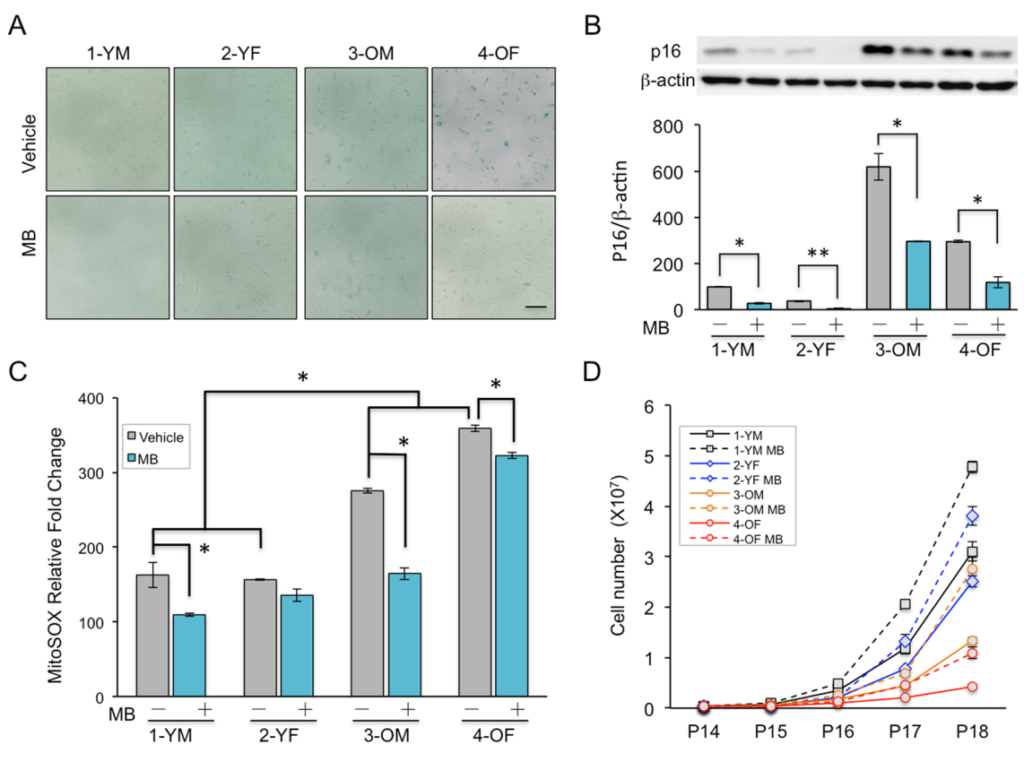
Source: Xiong et al., Scientific Reports (2017). Figure reproduced from the cited research article under the source article's stated Creative Commons licensing.
And what about grey hair?
Greying is considerably more complicated than simply running out of pigment. It involves melanocyte biology, ageing, genetics and changes in the follicular environment.
Mitochondrial biology is one piece of the wider ageing puzzle, which is why it sometimes appears in conversations about hair pigmentation and cellular ageing.
But there is an important distinction: there is currently no established evidence that methylene blue reverses grey hair in humans.
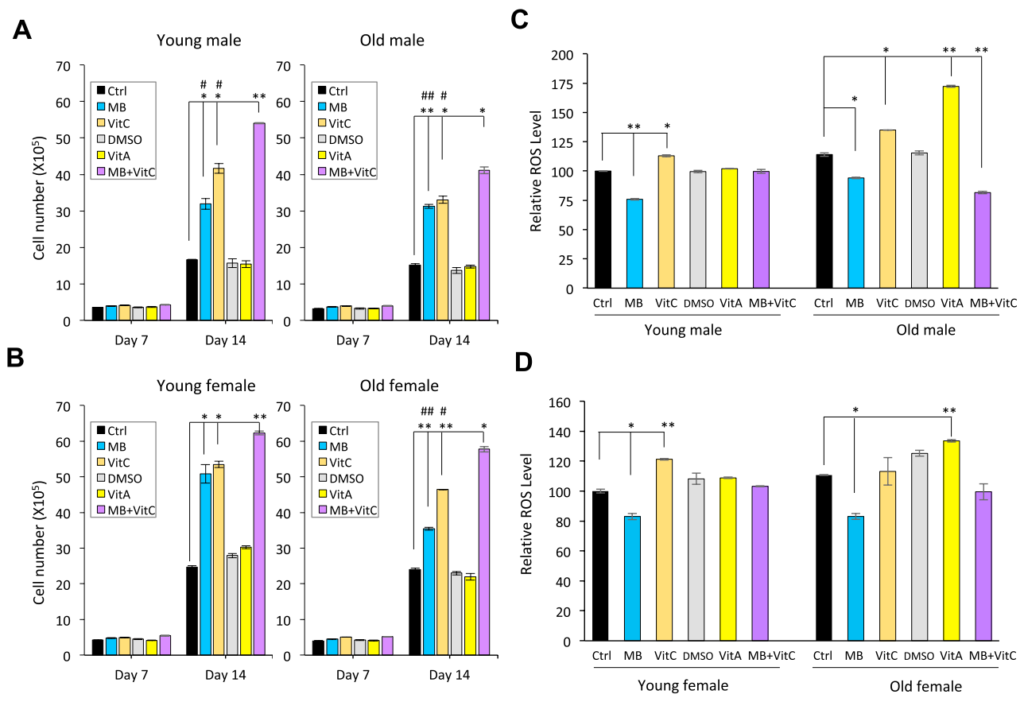
These findings concern cellular biology and should not be interpreted as evidence that methylene blue reverses human hair greying.
Source: Xiong et al., Scientific Reports (2017). Figure reproduced from the cited research article under the source article's stated Creative Commons licensing.
What about oxidative stress?
Oxidative stress is another reason methylene blue has attracted attention.
Reactive oxygen species are normal products of cellular metabolism. Problems can arise when their production and the cell's antioxidant systems become imbalanced.
Research has explored whether methylene blue can influence these pathways in cultured cells. Some experiments have reported reductions in markers of oxidative stress.
Again, the important word is research. These experiments help researchers understand a mechanism. They do not establish that taking methylene blue will produce the same effect in a person's scalp.

The experiment provides mechanistic information about cellular responses; it is not a clinical hair loss trial.
Source: Xiong et al., Scientific Reports (2021). Figure reproduced from the cited research article under the source article's stated Creative Commons licensing.
What the research supports
- Methylene blue is biologically active and redox-sensitive.
- It has been investigated in mitochondrial and oxidative-stress research.
- Laboratory studies have reported effects on several cellular markers.
- These mechanisms provide reasons for continued scientific investigation.
What remains unanswered
- Whether it reliably regrows hair in humans.
- Whether it reverses established grey hair.
- Which dose, route or formulation would be appropriate for any hair-related application.
- Whether long-term cosmetic use is safe and effective.
So, can methylene blue regrow hair?
The most accurate answer is: we do not know.
The available research provides interesting biological hypotheses, particularly around mitochondrial function, oxidative stress and cellular ageing. But those findings largely come from laboratory and preclinical research.
The distinction matters because many compounds can influence cells in a laboratory without becoming effective treatments in people.
Interesting biology. Limited hair evidence.
The research surrounding methylene blue is scientifically interesting, but the evidence for human hair regrowth remains insufficient to call it an established treatment.
Methylene blue is a pharmacologically active compound and should not be treated as an ordinary wellness ingredient. It can interact with serotonergic medicines and may pose serious risks for people with G6PD deficiency. Reported adverse effects can include nausea, dizziness, headache and discoloration of urine or other tissues. Anyone considering use should discuss it with an appropriately qualified healthcare professional, particularly if taking prescription medication or if they have an underlying medical condition.
The bigger picture: cellular health
What makes methylene blue interesting is not a simple promise of thicker hair. It is the broader scientific question surrounding how cells maintain energy, manage oxidative stress and respond to ageing.
Hair follicles are part of that biology, but the distance between an interesting cellular mechanism and a proven human treatment is substantial.
For now, methylene blue belongs in the category of compounds that deserve continued investigation — rather than one that can responsibly be presented as a proven solution for hair loss or grey hair.